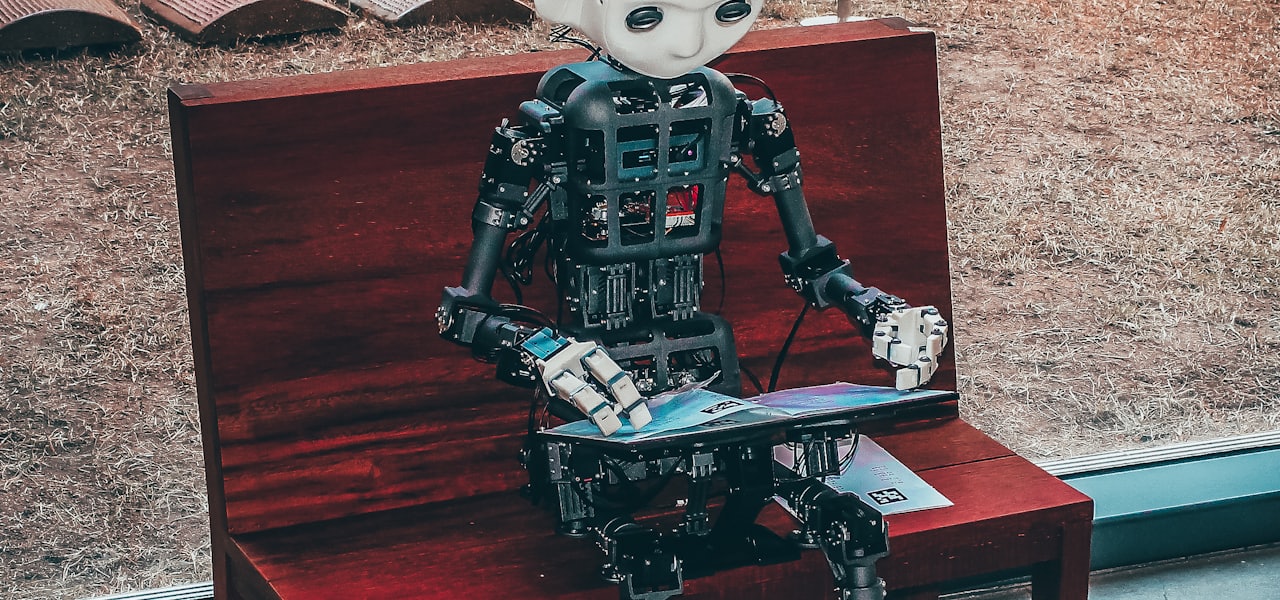
Action model learning (sometimes abbreviated action learning) is an area of machine learning concerned with the creation and modification of a software agent's knowledge about the effects and preconditions of the actions that can be executed within its environment. This knowledge is usually represented in a logic-based action description language and used as input for automated planners. Learning action models is important when goals change. When an agent acted for a while, it can use its accumulated knowledge about actions in the domain to make better decisions. Thus, learning action models differs from reinforcement learning. It enables reasoning about actions instead of expensive trials in the world. Action model learning is a form of inductive reasoning, where new knowledge is generated based on the agent's observations. The usual motivation for action model learning is the fact that manual specification of action models for planners is often a difficult, time-consuming, and error-prone task (especially in complex environments). == Action models == Given a training set E {\displaystyle E} consisting of examples e = ( s , a , s ′ ) {\displaystyle e=(s,a,s')} , where s , s ′ {\displaystyle s,s'} are observations of a world state from two consecutive time steps t , t ′ {\displaystyle t,t'} and a {\displaystyle a} is an action instance observed in time step t {\displaystyle t} , the goal of action model learning in general is to construct an action model ⟨ D , P ⟩ {\displaystyle \langle D,P\rangle } , where D {\displaystyle D} is a description of domain dynamics in action description formalism like STRIPS, ADL or PDDL and P {\displaystyle P} is a probability function defined over the elements of D {\displaystyle D} . However, many state of the art action learning methods assume determinism and do not induce P {\displaystyle P} . In addition to determinism, individual methods differ in how they deal with other attributes of domain (e.g. partial observability or sensoric noise). == Action learning methods == === State of the art === Recent action learning methods take various approaches and employ a wide variety of tools from different areas of artificial intelligence and computational logic. As an example of a method based on propositional logic, we can mention SLAF (Simultaneous Learning and Filtering) algorithm, which uses agent's observations to construct a long propositional formula over time and subsequently interprets it using a satisfiability (SAT) solver. Another technique, in which learning is converted into a satisfiability problem (weighted MAX-SAT in this case) and SAT solvers are used, is implemented in ARMS (Action-Relation Modeling System). Two mutually similar, fully declarative approaches to action learning were based on logic programming paradigm Answer Set Programming (ASP) and its extension, Reactive ASP. In another example, bottom-up inductive logic programming approach was employed. Several different solutions are not directly logic-based. For example, the action model learning using a perceptron algorithm or the multi level greedy search over the space of possible action models. In the older paper from 1992, the action model learning was studied as an extension of reinforcement learning. Nonetheless, further algorithms can be found that operate under different assumptions: FAMA can work even when some observations are missing, and it produces a general (lifted) planning model. It treats learning an action model like a planning problem, making sure the learned model matches the observations given. NOLAM can learn general action models even from noisy or imperfect data. LOCM focuses only on the order of actions in the data, ignoring any details about the states between those actions. The family of safe action model (SAM) learning methods create models that guarantee any plans made with them will actually work in the real world. There's also an extension called N-SAM that can learn action models with numeric conditions and effects. Additionally, numeric action models like N-SAM can be used to improve reinforcement learning (RL) performance through the RAMP algorithm. === Literature === Most action learning research papers are published in journals and conferences focused on artificial intelligence in general (e.g. Journal of Artificial Intelligence Research (JAIR), Artificial Intelligence, Applied Artificial Intelligence (AAI) or AAAI conferences). Despite mutual relevance of the topics, action model learning is usually not addressed in planning conferences like the International Conference on Automated Planning and Scheduling (ICAPS).
Log shipping
Log shipping is the process of automating the backup of transaction log files on a primary (production) database server, and then restoring them onto a standby server. This technique is supported by Microsoft SQL Server, 4D Server, MySQL, and PostgreSQL. Similar to replication, the primary purpose of log shipping is to increase database availability by maintaining a backup server that can replace a production server quickly. Other databases such as Adaptive Server Enterprise and Oracle Database support the technique but require the Database Administrator to write code or scripts to perform the work. Although the actual failover mechanism in log shipping is manual, this implementation is often chosen due to its low cost in human and server resources, and ease of implementation. In comparison, SQL server clusters enable automatic failover, but at the expense of much higher storage costs. Compared to database replication, log shipping does not provide as much in terms of reporting capabilities, but backs up system tables along with data tables, and locks the standby server from users' modifications. A replicated server can be modified (e.g. views) and is therefore unsuitable for failover purposes.
Blocks world
The blocks world is a planning domain in artificial intelligence. It consists of a set of wooden blocks of various shapes and colors sitting on a table. The goal is to build one or more vertical stacks of blocks. Only one block may be moved at a time: it may either be placed on the table or placed atop another block. Because of this, any blocks that are, at a given time, under another block cannot be moved. Moreover, some kinds of blocks cannot have other blocks stacked on top of them. The simplicity of this toy world lends itself readily to classical symbolic artificial intelligence approaches, in which the world is modeled as a set of abstract symbols which may be reasoned about. == Motivation == Artificial Intelligence can be researched in theory and with practical applications. The problem with most practical applications is that the engineers don't know how to program an AI system. Instead of rejecting the challenge at all the idea is to invent an easy to solve domain which is called a toy problem. Toy problems were invented with the aim to program an AI which can solve it. The blocks world domain is an example of a toy problem. Its major advantage over more realistic AI applications is that many algorithms and software programs are available which can handle the situation. This allows comparing different theories against each other. In its basic form, the blocks world problem consists of cubes of the same size which have all the color black. A mechanical robot arm has to pick and place the cubes. More complicated derivatives of the problem consist of cubes of different sizes, shapes and colors. From an algorithmic perspective, blocks world is an NP-hard search and planning problem. The task is to bring the system from an initial state into a goal state. Automated planning and scheduling problems are usually described in the Planning Domain Definition Language (PDDL) notation which is an AI planning language for symbolic manipulation tasks. If something was formulated in the PDDL notation, it is called a domain. Therefore, the task of stacking blocks is a blocks world domain which stands in contrast to other planning problems like the dock worker robot domain and the monkey and banana problem. == Theses/projects which took place in a blocks world == Terry Winograd's SHRDLU Patrick Winston's Learning Structural Descriptions from Examples and Copy Demo Gerald Jay Sussman's Sussman anomaly Decision problem (Gupta and Nau, 1992): Given a starting Blocks World, an ending Blocks World, and an integer L > 0, is there a way to move the blocks to change the starting position to the ending position with L or less steps? This decision problem is NP-hard.
The Sword in the Stoned
"The Sword in the Stoned" is the fifth episode of the second season of the American fantasy comedy television series Ted. Written by Julius Sharpe, and directed by Seth MacFarlane, it premiered on the American streaming service Peacock, along with the rest of season two, on March 5, 2026. The series acts as a precursor to the Ted film franchise, showcasing the childhood lives of the protagonists. The series, set in 1994, focuses on John Bennett (Max Burkholder), the series' primary protagonist, an awkward high-school aged boy; along with Ted (MacFarlane), the series' titular anthropomorphic teddy bear. The two live with John's family, Susan (Alanna Ubach), his mild mannered mother, and Matty (Scott Grimes), his conservative father. Also residing with the family is Blaire (Giorgia Whigham), his radically liberal cousin whom often clashes with Matty. In the episode, Ted and John join the school play so they can have more extracurricular activities for their college applications, but the latter grows a connection with the school's popular teenager, Erin (Francesca Xuereb). Concurrently, Susan and Matty get a job at Dunkin' Donuts to help with their financial troubles, and Matty is given an opportunity to tell off Bill Clinton. Burkholder wore prop armor during the episode's play scenes. Bill Clinton’s appearance in the episode was portrayed by MacFarlane. After conventional makeup and visual techniques failed to convincingly resemble Clinton, the production used artificial intelligence to digitally replace MacFarlane's face with Clinton's likeness. Upon release, the episode received generally positive reviews from critics, though the use of AI in the Clinton scene was polarizing among audiences and reviewers. == Plot == John tells Ted that he is the last single guy left at their school, to which Ted points out the popular, single cheerleader, Erin, but John dismisses this. At home, Blaire tells John that he needs extracurricular activities to get into college, while Susan and Matty discuss their financial troubles, especially regarding John's college tuition. Looking over their options, they decide to audition for a school production of the play Camelot. Matty takes a job at Dunkin' Donuts, despite being told that nobody will give him a tip, and having to wear an incorrect name tag. Waiting for their auditions, John and Ted watch several poor auditions for the play before seeing Erin's, who delivers a flawless performance; John and Ted do less serious auditions, getting cast as knights, while Erin gets the role of Guinevere. Matty complains about his low salary, and Susan decides to get a job at Dunkin' Donuts beside him to help earn more income. Erin clashes with Lancelot's actor while rehearsing, and John compliments her performance, which she ignores, but, seeing Ted and John give good performances in a repetition exercise, she becomes interested in him, particularly since he treats her better than her stage-partner. Matty and Susan watch an employee training video, explaining how they should treat customers politely, not affecting Matty's nihilistic attitude. The manager announces that Bill Clinton is visiting their Dunkin' Donuts for publicity, and Matty sees this as a chance to tell Bill off. John and Erin practice lines, as she reveals the show is being taped so it can be sent to Emerson College in hopes of her getting in; Erin asks John to go out with her after the show. At dinner, Matty enthusiastically reveals what he plans to tell Bill, as John becomes stressed about the play when Susan tells there will be a large audience. Bill comes to the Dunkin' Donuts, and, seeing Matty is nervously insulting him, stages a private meeting with him, where Bill yells at Matty, calling him a loser before posing for a picture with Matty and subsequently throwing the cold coffee onto him. To ease the pressure, Ted and John take edibles from Blaire, but learn at the show that they contained mushrooms, causing them to stress further. On stage, Ted and John yell nervously that they're on drugs as the latter urinates in his costume, causing Erin to angrily storm off. == Production == "The Sword in the Stoned" was directed by series creator and lead Seth MacFarlane, and written by Julius Sharpe in his third and final writing credit for the series. When Ted and John are doing repetition exercises, they tackle each other to the ground, which required a stuntman named Ashton to play the role of Ted, according to Max Burkholder, who portrays John. Burkholder also recalled that, when Ted was choking John in the scene, he kept making a noise during the choking, which made Bill, the cameraman, laugh, despite being a "stone face" that never laughs, noting that seeing him be amused by the noise he was making assured Burkholder that what he was doing was "hilarious". Burkholder found the filming of the play scenes "weird", as he was put in fake armor with a hose inside his suit—which was filled with water mixed with yellow food coloring—that was made to create the urine stream that comes out of John's armor in the episode; he also noted that it took around 45 minutes to put on and take off the armor. He revealed that he himself had to urinate during the filming, as doing a scene about a character having to do so "really [broke] my brain", with the fact that it took 45 minutes to get the suit off adding to the frustration. Jennifer Ashley Connell, who worked for wardrobe, had to repeatedly go to Burkholder quickly between takes to dry off his pants with two hair dryers to make it look like the fake urine hadn't already streamed down his pants, so they could get as many shots of it as possible. Francesca Xuereb guest stars in the episode as Erin, the cheerleader who stars in the play. Incumbent president Bill Clinton was portrayed by MacFarlane, with artificial intelligence (AI) being used to digitally make MacFarlane's face look like Clinton's during post-production. Before settling on AI, the crew tried to use traditional computer-generated imagery and prosthetics, which made him look "terrifying", resulting in them deciding that AI would give them a more accurate look. One of the original technologies considered was one where, after scanning MacFarlane, a mesh of his head was created, and they had to use computer graphics to replace MacFarlane's face with Clinton's. An issue was faced, however, when they found the archival footage used as reference from the Clinton Library—an official Presidential Library containing information related to Clinton—to be extremely low-quality, making it hard to properly emulate his face, since only still images were of acceptable quality, and there weren't references of his moving face to work off of. A forensic artist was hired to help with this, and they created a 3D model of Clinton's head in ZBrush, based off of his presidential portrait. The model head worked for still frames, but movement was still difficult to do realistically, due to it being made for a "single-point perspective", which made details like the cheekbones or other minor issues more noticeable when using it for the scene. Since this did not work, AI was ultimately chosen through the studio Deep Voodoo, which used large language models to teach the tool how to correctly replicate Clinton's appearance. Defending the episode's use of AI, MacFarlane noted that the crew did not want people to focus on the tool being used, trying to utilize it in a way that wouldn't distract from the humor and narrative. Like the rest of the series, the episode was shot using ViewScreen; MacFarlane was able to act live with the cast as Ted due to ViewScreen, a technology that allows the production crew to visualize what Ted will look like in each scene in real time. == Release and reception == "The Sword in the Stoned" was first released on March 5, 2026, on the American streaming service Peacock, along with the rest of the second season. Nate Richards of Collider highlighted the Dunkin' Donuts subplot as an example of Scott Grimes delivering a "lot of laughs" through his performance as Matty. Dustin Rowles of Pajiba called "The Sword in the Stoned" one of the season's many episodes he'd recommend, particularly for the scenes of Ted and John being high on mushrooms during the play. Oppositely, Nick Valdez of ComicBook.com ranked the episode as the worst of the second season, criticizing it for not having a "huge impact" on the Bennett family dynamic like other episodes of the season do, and Susan and Matty's side story as the main reason he felt it was "[kept] from being great". Valdez noted the episode for likely being an advertisement for Dunkin' Donuts, calling the plot's ending scene involving Clinton the reason "it just all sticks out like a sore thumb". === Response to AI usage === The episode's use of AI for MacFarlane's portrayal of Clinton proved controversial, mainly on social media, where audiences asserted that the crew should have gotten an actor that resembl
Ordered weighted averaging
In applied mathematics, specifically in fuzzy logic, the ordered weighted averaging (OWA) operators provide a parameterized class of mean type aggregation operators. They were introduced by Ronald R. Yager. Many notable mean operators such as the max, arithmetic average, median and min, are members of this class. They have been widely used in computational intelligence because of their ability to model linguistically expressed aggregation instructions. == Definition == An OWA operator of dimension n {\displaystyle \ n} is a mapping F : R n → R {\displaystyle F:\mathbb {R} ^{n}\rightarrow \mathbb {R} } that has an associated collection of weights W = [ w 1 , … , w n ] {\displaystyle \ W=[w_{1},\ldots ,w_{n}]} lying in the unit interval and summing to one and with F ( a 1 , … , a n ) = ∑ j = 1 n w j b j {\displaystyle F(a_{1},\ldots ,a_{n})=\sum _{j=1}^{n}w_{j}b_{j}} where b j {\displaystyle b_{j}} is the jth largest of the a i {\displaystyle a_{i}} . By choosing different W one can implement different aggregation operators. The OWA operator is a non-linear operator as a result of the process of determining the bj. == Notable OWA operators == F ( a 1 , … , a n ) = max ( a 1 , … , a n ) {\displaystyle \ F(a_{1},\ldots ,a_{n})=\max(a_{1},\ldots ,a_{n})} if w 1 = 1 {\displaystyle \ w_{1}=1} and w j = 0 {\displaystyle \ w_{j}=0} for j ≠ 1 {\displaystyle j\neq 1} F ( a 1 , … , a n ) = min ( a 1 , … , a n ) {\displaystyle \ F(a_{1},\ldots ,a_{n})=\min(a_{1},\ldots ,a_{n})} if w n = 1 {\displaystyle \ w_{n}=1} and w j = 0 {\displaystyle \ w_{j}=0} for j ≠ n {\displaystyle j\neq n} F ( a 1 , … , a n ) = a v e r a g e ( a 1 , … , a n ) {\displaystyle \ F(a_{1},\ldots ,a_{n})=\mathrm {average} (a_{1},\ldots ,a_{n})} if w j = 1 n {\displaystyle \ w_{j}={\frac {1}{n}}} for all j ∈ [ 1 , n ] {\displaystyle j\in [1,n]} == Properties == The OWA operator is a mean operator. It is bounded, monotonic, symmetric, and idempotent, as defined below. == Characterizing features == Two features have been used to characterize the OWA operators. The first is the attitudinal character, also called orness. This is defined as A − C ( W ) = 1 n − 1 ∑ j = 1 n ( n − j ) w j . {\displaystyle A-C(W)={\frac {1}{n-1}}\sum _{j=1}^{n}(n-j)w_{j}.} It is known that A − C ( W ) ∈ [ 0 , 1 ] {\displaystyle A-C(W)\in [0,1]} . In addition A − C(max) = 1, A − C(ave) = A − C(med) = 0.5 and A − C(min) = 0. Thus the A − C goes from 1 to 0 as we go from Max to Min aggregation. The attitudinal character characterizes the similarity of aggregation to OR operation(OR is defined as the Max). The second feature is the dispersion. This defined as H ( W ) = − ∑ j = 1 n w j ln ( w j ) . {\displaystyle H(W)=-\sum _{j=1}^{n}w_{j}\ln(w_{j}).} An alternative definition is E ( W ) = ∑ j = 1 n w j 2 . {\displaystyle E(W)=\sum _{j=1}^{n}w_{j}^{2}.} The dispersion characterizes how uniformly the arguments are being used. == Type-1 OWA aggregation operators == The above Yager's OWA operators are used to aggregate the crisp values. Can we aggregate fuzzy sets in the OWA mechanism? The Type-1 OWA operators have been proposed for this purpose. So the type-1 OWA operators provides us with a new technique for directly aggregating uncertain information with uncertain weights via OWA mechanism in soft decision making and data mining, where these uncertain objects are modelled by fuzzy sets. The type-1 OWA operator is defined according to the alpha-cuts of fuzzy sets as follows: Given the n linguistic weights { W i } i = 1 n {\displaystyle \left\{{W^{i}}\right\}_{i=1}^{n}} in the form of fuzzy sets defined on the domain of discourse U = [ 0 , 1 ] {\displaystyle U=[0,\;\;1]} , then for each α ∈ [ 0 , 1 ] {\displaystyle \alpha \in [0,\;1]} , an α {\displaystyle \alpha } -level type-1 OWA operator with α {\displaystyle \alpha } -level sets { W α i } i = 1 n {\displaystyle \left\{{W_{\alpha }^{i}}\right\}_{i=1}^{n}} to aggregate the α {\displaystyle \alpha } -cuts of fuzzy sets { A i } i = 1 n {\displaystyle \left\{{A^{i}}\right\}_{i=1}^{n}} is given as Φ α ( A α 1 , … , A α n ) = { ∑ i = 1 n w i a σ ( i ) ∑ i = 1 n w i | w i ∈ W α i , a i ∈ A α i , i = 1 , … , n } {\displaystyle \Phi _{\alpha }\left({A_{\alpha }^{1},\ldots ,A_{\alpha }^{n}}\right)=\left\{{{\frac {\sum \limits _{i=1}^{n}{w_{i}a_{\sigma (i)}}}{\sum \limits _{i=1}^{n}{w_{i}}}}\left|{w_{i}\in W_{\alpha }^{i},\;a_{i}}\right.\in A_{\alpha }^{i},\;i=1,\ldots ,n}\right\}} where W α i = { w | μ W i ( w ) ≥ α } , A α i = { x | μ A i ( x ) ≥ α } {\displaystyle W_{\alpha }^{i}=\{w|\mu _{W_{i}}(w)\geq \alpha \},A_{\alpha }^{i}=\{x|\mu _{A_{i}}(x)\geq \alpha \}} , and σ : { 1 , … , n } → { 1 , … , n } {\displaystyle \sigma :\{\;1,\ldots ,n\;\}\to \{\;1,\ldots ,n\;\}} is a permutation function such that a σ ( i ) ≥ a σ ( i + 1 ) , ∀ i = 1 , … , n − 1 {\displaystyle a_{\sigma (i)}\geq a_{\sigma (i+1)},\;\forall \;i=1,\ldots ,n-1} , i.e., a σ ( i ) {\displaystyle a_{\sigma (i)}} is the i {\displaystyle i} th largest element in the set { a 1 , … , a n } {\displaystyle \left\{{a_{1},\ldots ,a_{n}}\right\}} . The computation of the type-1 OWA output is implemented by computing the left end-points and right end-points of the intervals Φ α ( A α 1 , … , A α n ) {\displaystyle \Phi _{\alpha }\left({A_{\alpha }^{1},\ldots ,A_{\alpha }^{n}}\right)} : Φ α ( A α 1 , … , A α n ) − {\displaystyle \Phi _{\alpha }\left({A_{\alpha }^{1},\ldots ,A_{\alpha }^{n}}\right)_{-}} and Φ α ( A α 1 , … , A α n ) + , {\displaystyle \Phi _{\alpha }\left({A_{\alpha }^{1},\ldots ,A_{\alpha }^{n}}\right)_{+},} where A α i = [ A α − i , A α + i ] , W α i = [ W α − i , W α + i ] {\displaystyle A_{\alpha }^{i}=[A_{\alpha -}^{i},A_{\alpha +}^{i}],W_{\alpha }^{i}=[W_{\alpha -}^{i},W_{\alpha +}^{i}]} . Then membership function of resulting aggregation fuzzy set is: μ G ( x ) = ∨ α : x ∈ Φ α ( A α 1 , ⋯ , A α n ) α α {\displaystyle \mu _{G}(x)=\mathop {\vee } _{\alpha :x\in \Phi _{\alpha }\left({A_{\alpha }^{1},\cdots ,A_{\alpha }^{n}}\right)_{\alpha }}\alpha } For the left end-points, we need to solve the following programming problem: Φ α ( A α 1 , ⋯ , A α n ) − = min W α − i ≤ w i ≤ W α + i A α − i ≤ a i ≤ A α + i ∑ i = 1 n w i a σ ( i ) / ∑ i = 1 n w i {\displaystyle \Phi _{\alpha }\left({A_{\alpha }^{1},\cdots ,A_{\alpha }^{n}}\right)_{-}=\min \limits _{\begin{array}{l}W_{\alpha -}^{i}\leq w_{i}\leq W_{\alpha +}^{i}A_{\alpha -}^{i}\leq a_{i}\leq A_{\alpha +}^{i}\end{array}}\sum \limits _{i=1}^{n}{w_{i}a_{\sigma (i)}/\sum \limits _{i=1}^{n}{w_{i}}}} while for the right end-points, we need to solve the following programming problem: Φ α ( A α 1 , ⋯ , A α n ) + = max W α − i ≤ w i ≤ W α + i A α − i ≤ a i ≤ A α + i ∑ i = 1 n w i a σ ( i ) / ∑ i = 1 n w i {\displaystyle \Phi _{\alpha }\left({A_{\alpha }^{1},\cdots ,A_{\alpha }^{n}}\right)_{+}=\max \limits _{\begin{array}{l}W_{\alpha -}^{i}\leq w_{i}\leq W_{\alpha +}^{i}A_{\alpha -}^{i}\leq a_{i}\leq A_{\alpha +}^{i}\end{array}}\sum \limits _{i=1}^{n}{w_{i}a_{\sigma (i)}/\sum \limits _{i=1}^{n}{w_{i}}}} Zhou et al. presented a fast method to solve two programming problem so that the type-1 OWA aggregation operation can be performed efficiently. == OWA for committee voting == Amanatidis, Barrot, Lang, Markakis and Ries present voting rules for multi-issue voting, based on OWA and the Hamming distance. Barrot, Lang and Yokoo study the manipulability of these rules.
Message queuing service
A message queueing service is a message-oriented middleware or MOM deployed in a compute cloud using software as a service model. Service subscribers access queues and or topics to exchange data using point-to-point or publish and subscribe patterns. It's important to differentiate between event-driven and message-driven (aka queue driven) services: Event-driven services (e.g. AWS SNS) are decoupled from their consumers. Whereas queue / message driven services (e.g. AWS SQS) are coupled with their consumers. Message queues can be a good buffer to handle spiky workloads but they have a finite capacity. According to Gregor Hohpe, message queues require proper mechanisms (aka flow controls) to avoid filling the queue beyond its manageable capacity and to keep the system stable. == Ordering Guarantees in Message Queues == Amazon SQS FIFO and Azure Service Bus sessions are queue-based messaging systems that provide ordering guarantees within a message group or session attempt but do not necessarily guarantee ordered delivery in cases of retries or failures. In SQS FIFO, messages in the same message group are processed in order, with subsequent messages held until the preceding message is successfully processed or moved to the dead-letter queue (DLQ). Once a message is placed in the DLQ, it is no longer retried, creating a gap in the sequence. However, the remaining messages continue to be delivered in order. Azure Service Bus sessions function similarly by maintaining ordering within a session, provided a single consumer processes messages sequentially. The implementation differs from SQS FIFO but follows the same fundamental ordering principle. In contrast, Apache Kafka is a distributed log-based messaging system that guarantees ordering within individual partitions rather than across the entire topic. Unlike queue-based systems, Kafka retains messages in a durable, append-only log, allowing multiple consumers to read at different offsets. Kafka uses manual offset management, giving consumers control over retries and failure handling. If a consumer fails to process a message, it can delay committing the offset, preventing further progress in that partition while other partitions remain unaffected. This partition-based design enables fault isolation and parallel processing while allowing ordering to be maintained within partitions, depending on consumer handling. == Vendors == Apache Kafka Apache Kafka is a distributed system consisting of servers that store and forward messages between producer client and consumer applications. IBM MQ IBM MQ offers a managed service that can be used on IBM Cloud and Amazon Web Services. Microsoft Azure Service Bus Service Bus offers queues, topics & subscriptions, and rules/actions in order to support publish-subscribe, temporal decoupling, and load balancing scenarios. Azure Service Bus is built on AMQP allowing any existing AMQP 1.0 client stack to interact with Service Bus directly or via existing .Net, Java, Node, and Python clients. Standard and Premium tiers allow for pay as you go or isolated resources at massive scale. Oracle Messaging Cloud Service This service provides a messaging solution for applications for asynchronous communication and is influenced by the Java Message Service (JMS) API specification. Any application platform that understands HTTP can also use Oracle Messaging Cloud Service through the REST interface. For Java applications, Oracle Messaging Cloud Service provides a Java library that implements and extends the JMS 1.1 interface. The Java library implements the JMS API by acting as a client of the REST API. Amazon Simple Queue Service Supports messages natively up to 256K, or up to 2GB by transmitting payload via S3. Highly scalable, durable and resilient. Provides loose-FIFO and 'at least once' delivery in order to provide massive scale. Supports REST API and optional Java Message Service client. Low latency. Utilizes Amazon Web Services. IronMQ Supports messages up to 64k; guarantees order; guarantees once only delivery; no delays retrieving messages. Supports REST API and beanstalkd open source protocol. Runs on multiple clouds including AWS and Rackspace. Scaling must be managed by user. RabbitMQ RabbitMQ is a reliable and mature messaging and streaming broker, which is easy to deploy on cloud environments, on-premises, and on your local machine. Supports AMQP, STOMP, MQTT StormMQ Open platform supports messages up to 50Mb. Uses AMQP to avoid vendor lock-in and provide language neutrality. Locate-It Option allows customers to audit the location of their data at all times and satisfy data protection principles. AnypointMQ An enterprise multi-tenant, cloud messaging service that performs advanced asynchronous messaging scenarios between applications. Anypoint MQ is fully integrated with Anypoint Platform, offering role based access control, client application management, and connectors.
Argument Interchange Format
The Argument Interchange Format (AIF) is an international effort to develop a representational mechanism for exchanging argument resources between research groups, tools, and domains using a semantically rich language. AIF traces its history back to a 2005 colloquium in Budapest. The result of the work in Budapest was first published as a draft description in 2006. Building on this foundation, further work then used the AIF to build foundations for the Argument Web. AIF-RDF is the extended ontology represented in the Resource Description Framework Schema (RDFS) semantic language. The Argument Interchange Format introduces a small set of ontological concepts that aim to capture a common understanding of argument -- one that works in multiple domains (both domains of argumentation and also domains of academic research), so that data can be shared and re-used across different projects in different areas. These ontological concepts are: Information (I-nodes) Applications of Rules of Inference (RA-nodes) Applications of Rules of Conflict (CA-nodes) Applications of Rules of Preference (PA-nodes) extended by: Schematic Forms (F-nodes) that are instantiated by RA, CA and PA nodes The AIF has reifications in a variety of development environments and implementation languages including MySQL database schema RDF Prolog JSON as well as translations to visual languages such as DOT and SVG. AIF data can be accessed online at AIFdb.